



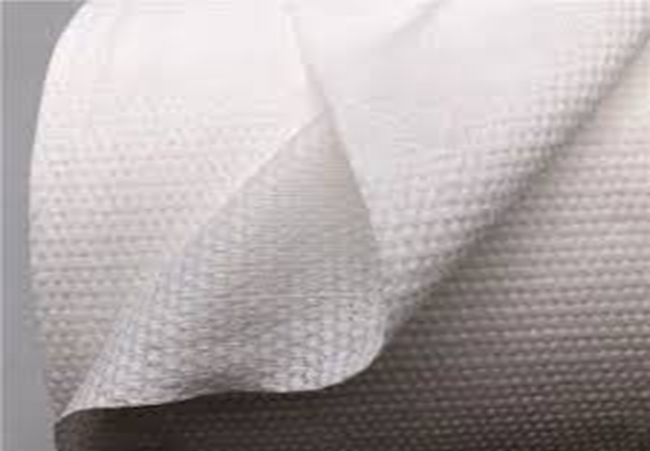

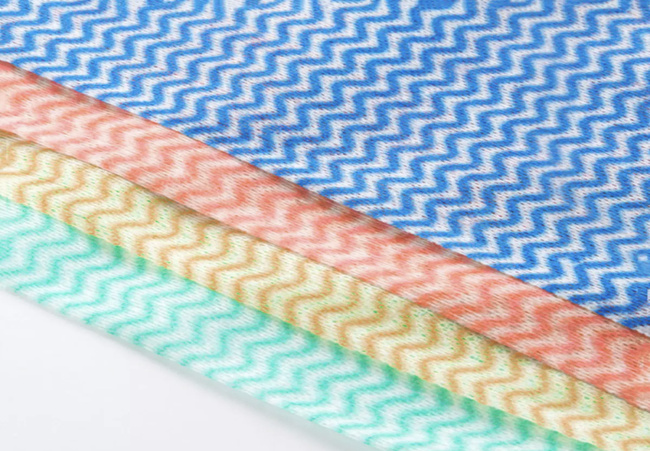
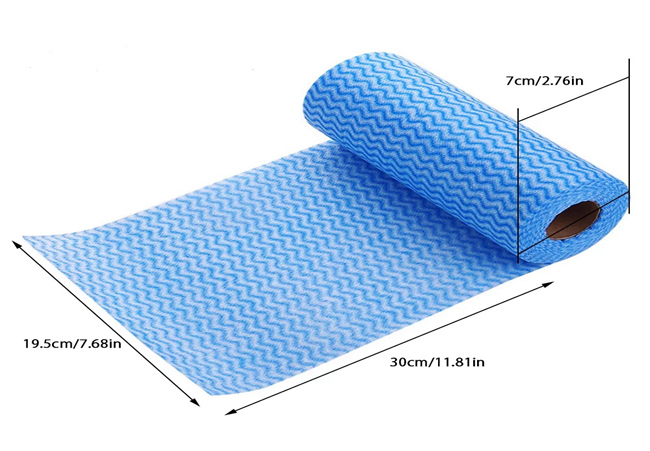
What is the spunlace nonwoven fabric ?
Spunlace nonwoven fabrics are made by spraying high-pressure fine water jets onto one or more layers of fiber webs, so that the fibers are entangled with each other, so that the fiber web is reinforced and has a certain strength. The resulting fabric is spunlace nonwoven fabrics.
Processing principle
Multiple fine water jets generated by high pressure are used to spray the fiber web. After the water jet passes through the fiber web, it is rebounded by the dragging net curtain and interspersed with the fiber web again. As a result, the fibers in the fiber web are displaced, interspersed, entangled and embraced under the hydraulic action of high-speed water jets in different directions, so that the fiber web is reinforced.
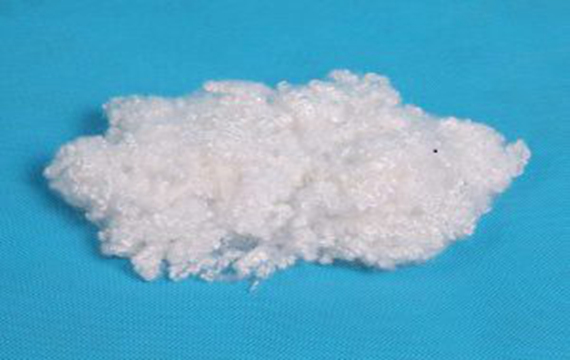
Spunlace nonwoven fabric raw material - short fibre
Spunlace nonwovens use short fibers as raw materials, the most popular of which are viscose fibers (38mm*1.67dtex) and polyester staple fibers (38mm*1.56dtex).
Sometimes polypropylene (PP) is also used in spunlace production.
Its fiber raw materials come from a wide range of sources, such as polyester, nylon, polypropylene, viscose, chitin, microfiber, Tencel, silk, bamboo fiber, wood pulp fiber, seaweed fiber, etc.
Features of spunlace
- Flexible entanglement, does not affect the original characteristics of the fiber, does not damage the fiber
- Appearance is closer to traditional textiles
- High strength, low fuzzing
- High hygroscopicity and fast moisture absorption
- Good breathability
- Soft feel, good drape
- Various appearance patterns
- Long production process, large floor space
- Complex equipment, high water quality requirements
- High energy consumption

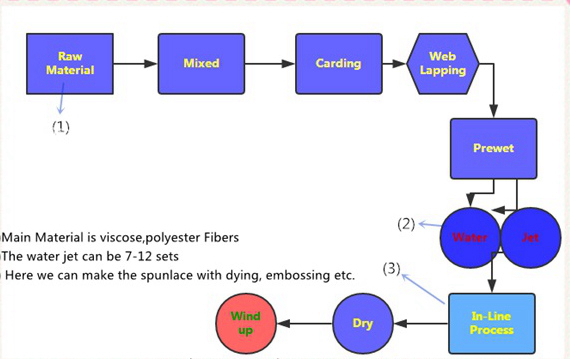
Spunlace process
A. Fiber raw materials → opening and mixing → combing → cross-laying → drawing →
→ pre-wetting → positive and negative hydroentanglement → finishing → drying → winding
↑↑
Water treatment cycle
B. Fiber raw materials – opening and mixing – combing and forming a messy web →
→ pre-wetting → front and back hydroentanglement – finishing → drying → winding
↑↑
Water treatment cycle
Different web-forming methods affect the longitudinal and transverse strength ratio of the final product.
Process A is better for adjusting the longitudinal and transverse strength ratio of the fiber web and is suitable for the production of spunlace synthetic leather base fabrics; Process B is suitable for the production of spunlace hygiene materials.
Spunlace Nonwoven Fabric Material Proportion
Due to the advantages of spunlace fabrics, it has become one of the fastest-growing areas in the nonwoven industry in recent years. The development direction of nonwoven fabrics is to replace textiles and knitwear. Spunlace fabrics have become the most promising area to compete with the textile market with their most textile-like characteristics, excellent physical properties, and advantages of good quality and low price.
Spunlace fabric material:polyester + viscose;
Material ratio; 100% polyester; 10% polyester + 90% viscose; 20% polyester + 80% viscose; 30% polyester + 70% viscose; 40% polyester + 60% viscose; 50% polyester + 50% viscose; 60% polyester + 40% viscose; 70% polyester + 30% viscose; 80% polyester + 20% viscose; 100% viscose.
For spunlace nonwoven fabrics, you need to provide the our factory with the specific material (polyester, viscose) ratio so that you can get a quote.

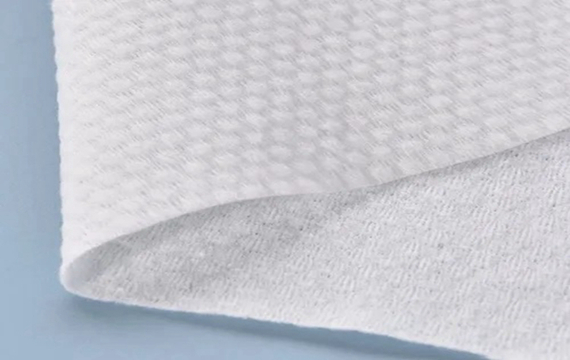
Spunlace nonwoven new technology
With the development of spunlace nonwoven technology, we have some new spunlace technologies, one of the most important is wood pulp spunlace. See the following figure for wood pulp spunlace process:

Woodpulp spunlace fabric is very popular now and can replace some ordinary spunlace fabrics. There are two types of this fabric:
Wood pulp polyester non-woven fabric & Wood pulp polypropylene non-woven fabric
These wood pulp non-woven fabrics are cheaper and are also good materials for spunlace non-woven fabrics.
Types of Spunlace Lapping Machines
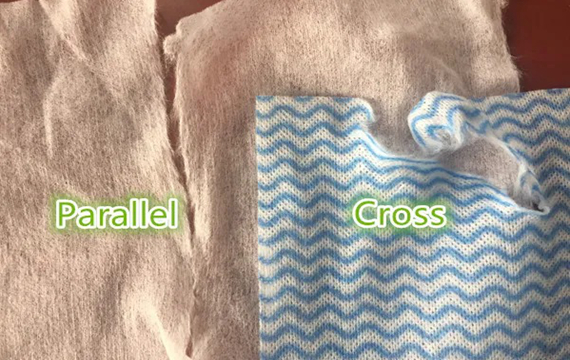
Based on the different lapping machine, spunlace have 2 types: Parallel lapped Spunlace Fabric & Cross Lapped Spunlace Fabric. What is the difference of Parallel lapped Spunlace Fabric & Cross Lapped Spunlace Fabric? The main difference is their fabric strength.Take 40gsm 100% polyester spunlace fabric for example, we see their data sheet as below:

The first table is a cross-lapped spunlace fabric, which has a relatively small difference in MD and CD strength values and is relatively uniform. For easier understanding, there is a photo on the right for you reference.
Parallel-laid spunlace fabrics can be easily torn in a vertical direction, while cross-laid spunlace fabrics are not so easy to tear and cannot be torn in a straight line. In this case, parallel-laid spunlace fabrics are mainly used for wet wipes, while cross-laid spunlace fabrics are more widely used for dry wipes or leather, etc.

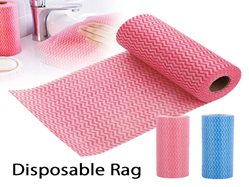
Nonwoven Related Products
How to check spunlace fabric quality?
Some customers have told us that they received the wrong or poor quality spunlace nonwovens. So how can you check if the spunlace nonwoven you received is of the right quality? It’s easy to do a lab test, or pay a third party to do it. But here we show you a very simple test method that you can do yourself.
The most important thing for spunlace fabric is its composition, because viscose is usually more expensive than polyester, and viscose makes spunlace fabrics more absorbent and have higher wiping qualities.
The simplest way to test a blend of viscose and polyester is to burn the fabric:

You can see a clear difference during the burning process.
Fabrics with higher polyester content burn faster and are not easy to extinguish. There will be black knots after burning. 100% viscose fiber will only be gray after burning without knots. So the faster the burning speed and the more knots, the more polyester content in the fabric.
We are a professional spunlace nonwoven manufacturer. We produce various spunlace nonwovens according to customer needs.