


RPET stands for (recycled) polyethylene terephthalate. It is mostly used in industry, packaging, clothing, and home textiles.
The R (recycle) in RPET means recycling or recovery in English.

Source of recycled polyester RPET
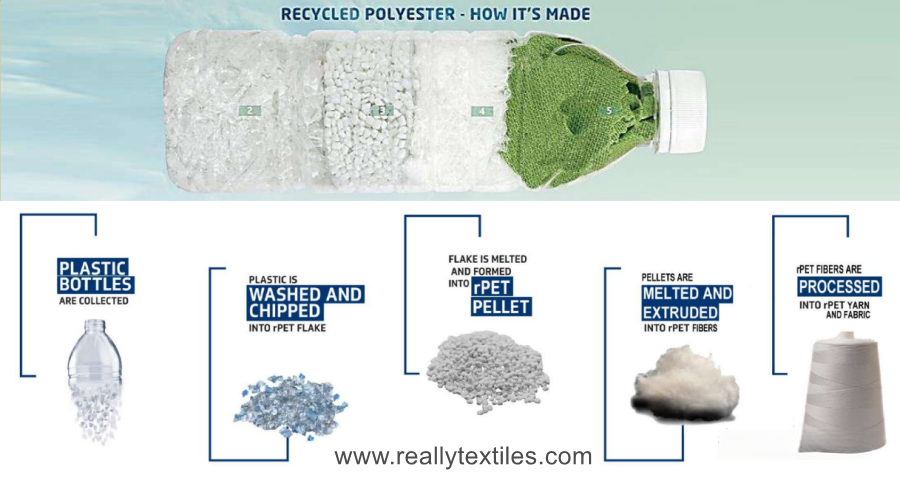
It refers to the use of waste polyester bottle flakes, spinning waste, foam material, and pulp blocks as raw materials, usually mineral water plastic bottles or cola bottles, the bottles are cut into small pieces, crushed, and the flakes are melted to separate the core PET components, regenerated granulation, spun into fibers and woven, which can be used to make anything.
Recycled polyester RPET production process
After recycling, crushing, washing, drying, melt extrusion, spinning, winding, bundling, drawing, curling (at the same time, different oils are added during curling according to customer needs), relaxation and heat setting, and cut to form polyester fibers of different lengths. Polyester is a synthetic material.
Usages of recycled PET pellets
PET bottles are made of polyethylene terephthalate, commonly known as PET. Whenever we pick up recyclables, we always pick PET bottles as the main material and other recyclables as the secondary material, because PET bottles are the most cost-effective when recycled, but their materials are easily confused with PVC materials.
Their characteristics are as follows: PET is transparent, tough, and has a barrier to carbon dioxide. It is often used in the packaging of carbonated beverages. The simplest way to identify it is that it is colorless and transparent. After adding color, it can become light green, light blue or brown. There is a dot on the bottom of the round PET bottle, and the bottle body has no seams.
The bottom of the PVC round bottle is a straight line. There will be white marks when it is bent. It will turn iron red after long-term exposure to sunlight. When burning its edge with fire, there will be a blue flame, and the burning property is poor.
PET bottles are widely used in carbonated beverages such as Coca-Cola, Pepsi, and Sprite. Currently, most of them are composed of PET bottle body and HDPE bottle bottom. The bottle cap material is HDPE, and the trademark is biaxially oriented polypropylene (BOPP) film, which is adhered to the bottle body with EVA type adhesive. The ways to recycle and reuse polyester bottles include regeneration granulation, alcoholysis and other methods.

Regardless of the method used, the polyester bottle must first be separated from other bottles, and the polyester bottle body must also be separated from the bottom of the bottle.
① Separation: The mixed and collected bottles are crushed in a crusher via a conveyor belt, and then separated by density.
② Regeneration granulation: Regeneration granulation can be done with an extruder. The separated PET fragments are extruded and granulated into granules by an extruder. In order to avoid water absorption during extrusion and reduce the physical viscosity, they should be dried before extrusion.
a. Remanufacture of PET bottles. Recycled granules cannot be used in direct contact with food, but can be used in the middle layer of three-layer PET bottles and then made into carbonated beverage bottles.
b. Spinning to make fibers. Recycled PET materials can be used to spin fibers for pillow cores, mattresses, sleeping bags, felts, etc.
c. Glass fiber reinforced materials. Recycled PET reinforced with glass fiber has good heat resistance and mechanical strength, and can be used to make automotive parts, such as heat-resistant car wheel covers, and its thermal distortion temperature can reach 240 degrees. Flexural elastic modulus 9500MPa, bending strength 214MPa, impact strength 15kf/m2.
d. Blending modification. Recycled PET polyester non-woven fabric can be blended with other polymers to obtain various modified materials. For example, blending with PE can obtain PET blends with improved impact performance. PE:PET is (10-50): (90-50): If a small amount of polypropylene is added, the dimensional stability of the blend can be significantly improved. Since the polarity of PE and PET is quite different, compatibility treatment is required during blending. Generally, the compatibility is improved by grafting modification of polyolefins.
③ Alcoholysis: PET waste is subjected to alcoholysis in the presence of an alkaline catalyst, and then dibasic acid anhydride is added for polycondensation to obtain a product with an acid value greater than 12. After dilution, filtration, and addition of an appropriate amount of catalyst, alkyd resin paint can be obtained. The formula is shown in the table below. The reaction temperature is 80~85 degrees and the reaction time is 4~5h.
